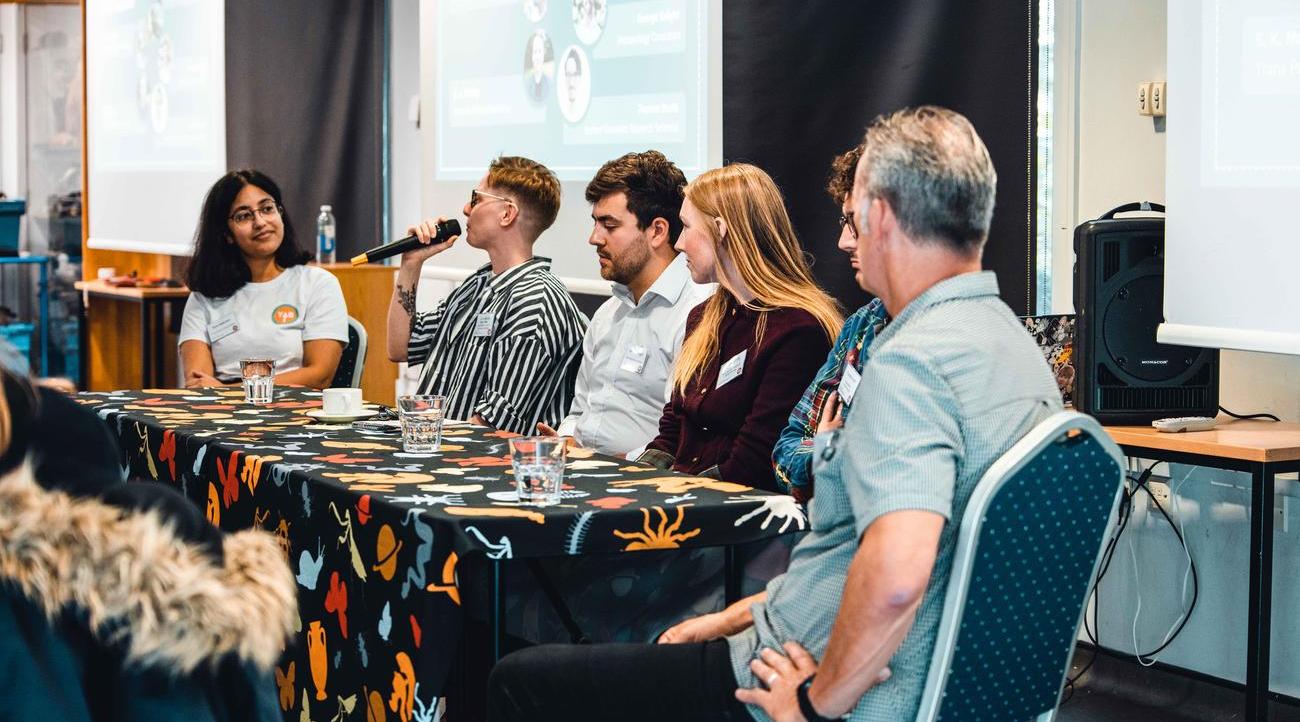
From engaging young people with archaeology at a careers event, to training group leaders on how to challenge the assumptions we make about the past, collaborating with the Council for British Archaeology (CBA) this past academic year has been a riot.
* Feature image credit: Council for British Archaeology. S. K. speaking at the Unearthing Futures event in Newcastle.
Unearthing Futures: a youth-led pathway into archaeology
In September 2025, CBA invited more than 100 young people to find out more about the different roles in archaeology and various routes into the field. Without any A-Levels or GCSEs in Archaeology available in England, young people have few opportunities to explore the subject in mainstream education. The Unearthing Futures event helped fill that gap.
Attendees could learn from professionals in landscape surveying, museum curation, archaeological illustration and how to read animal bones. They could also attend a careers panel, where participants could ask archaeologists questions. Here, I was asked about unusual or untypical ways into archaeology, referring to my work as a creative facilitator.
Speaking with the participants was a great experience and the event felt super impactful. I would’ve loved to attend it, back in the day!
Training day with Young Archaeologists’ Club leaders

In June this year I was invited to run a training workshop with Young Archaeologists’ Club (YAC) leaders with the British Council for Archaeology, to share ideas from queer archaeology and my project, Our Transcapes. YAC leaders run weekly or monthly archaeology clubs for young people, ranging from 8-18 years old, to inspire their interest and understanding of the field and of the past.
What is queer archaeology?
What assumptions do we make about prehistoric peoples who didn’t share our cultural norms? How can we train ourselves to read the few remains from their lives, beyond our own limited social lenses? Learning how to do this is, I think, life long work for all of us, but especially for archaeologists in the west. The world we’ve grown up in is inherently a colonial one, and that colonialism is still very much alive in the world.
As a trans person, I know first hand that our society’s notions of ‘normal’ and ‘fact’ must be ones we can challenge if we’re to interpret things around us, and that came before us, with open minds – to understand that other ways of being and seeing the world are not only possible, but valid.
Born within western colonialism, the field of archaeology in the west can reinvigorate those assumptions and continue to cause harm. One way it is being challenged is through the relatively new field of queer archaeology, which in of itself has many facets but ultimately introduces queer theory to how we read bodies, artefacts and landscapes of the past.
What we did
We began with a classic Our Transcapes guided walk, exploring evidence of prehistoric non-duality through artefacts and landscapes, before a workshop of activities for young people they could take to their clubs. Then, the Council and I created a resources pack from the day that all sorts of youth group leaders and teachers could use when thinking about reading history in open-minded ways.
Download the Our Transcapes resources pack.
Upcoming article in the British Archaeology Magazine
This winter I look forward to the publication of an article in CBA’s British Archaeology Magazine (issue 212), where I chat a little more about queering prehistory. Keep an eye out!
A massive thanks to CBA for these fab opportunities; I still pinch myself that folks are interested in this work, and as a long-time reader of the CBA website and magazine, it’s been incredible working with them.
Over and out x
Leave a Reply