It’s been a brilliant start to 2026, with two deliveries of Transcapes for different community groups in Sheffield already, and taking it to Devon this summer!
The bluebells are carpeting Sheffield’s woodland wonders and blossoms are arcing above our heads in city parks. What a time to get out and get queer about British prehistory, eh?
Springtime explorations
At the end of March, we took some members of SayIt Sheffield, a youth LGBTQ+ support charity, to Ecclesall Woods – a chunk of South Yorkshire’s ancient woodlands. Participants delighted in being outside together, climbing enormous beech trees, and finding magnificent mushrooms and triple conkers (a nice nod to non-dualist views of the world!)
They were particularly drawn to the Star Carr antler headdress, which they all had a go at wearing beside the large pond masquerading as a Mesolithic post-glacial lake. It was a fab afternoon, and I learned a lot about therian culture that some young folks identify with today – also very non-dual!
Bants on Bronze Age Barbrook: the prehistoric Peak
A gay bus takeover
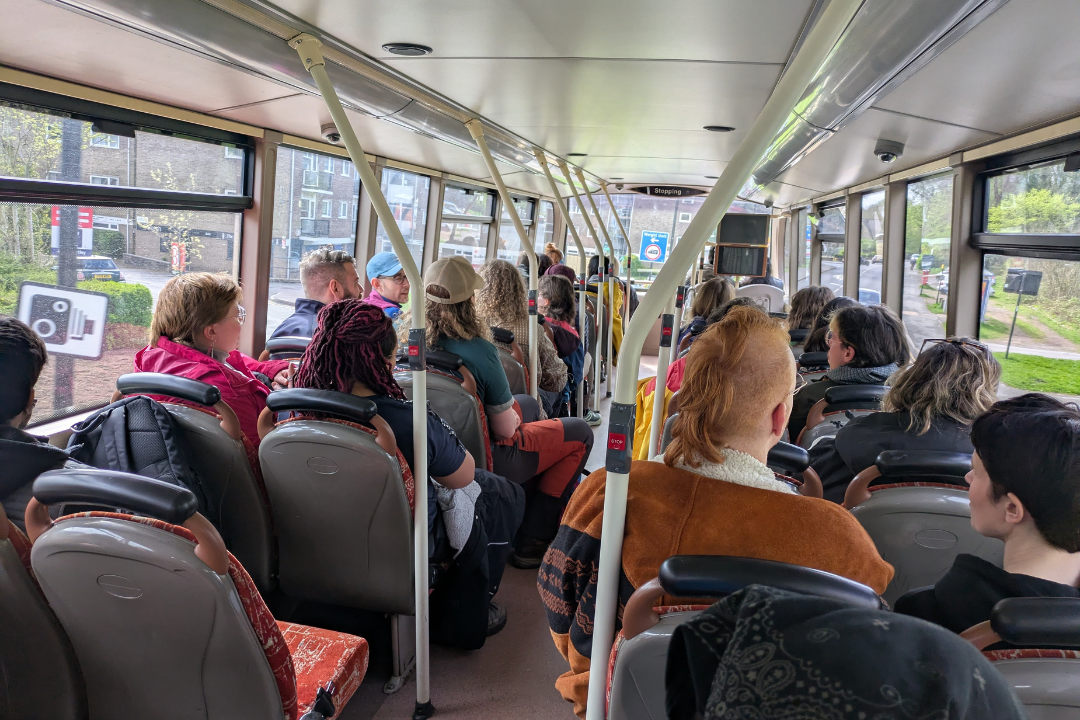
On Saturday last week, 37 (!) LGBTQ+ adults joined me on a longer, new route in Barbrook, the Peak District. I devised this route to take in some real monuments that could support our storytelling, as Barbrook has a vast array of Bronze Age field systems, evidence of houses, stone circles, and a cheeky cist that was rebuilt after being damaged in the 1980’s. Many cist artefacts are still held in Sheffield museums, meaning participants could easily go and explore more after the event.
The biggest challenge on Saturday was navigating the large herd of cattle, but we got there in the end! Having a longer route gave folks a lot of time to meet new people and be immersed in the landscape we traversed. It was a long day, being out in the powerful wind for so long, but many of the participants stayed for the whole shtick and even joined us afterwards for a pint back in Sheffield.
Since then, numerous folks have DM’d, asking for further reading recommendations for queering prehistoric Britain and ancient belief systems. It’s fantastic to see the content of Transcapes excite and attract people to such a degree – more than I could’ve dreamed of <3
Future expansions for Transcapes
Their requests for recommendations have highlighted, once again, the lack of accessible materials that explore these interdisciplinary themes. This is encouraging for the future development of Transcapes. It could be turned into a non-fiction work to gain wider reach, whether that’s through traditional publishing, or perhaps something a little more queer… we’ll see!
Coming up this summer, I’ll be taking Transcapes to the Out & Wild festival in Devon – also known as Glastonbury for lesbians. They won an award this year for being super inclusive – especially for trans* folks, which makes me confident it’s the right place for Transcapes. Let’s see how it goes!
As ever, if you’re interested in collaborating with me and putting on an Our Transcapes event in your area, get in touch!
After 18 months of development, Our Transcapes fully launched last week – and judging from the anonymous feedback, it’s achieved all that we at Queer Natures hoped it would.
Our project goals
I developed Our Transcapes to achieve three therapeutic goals for trans* folks: community building (reducing feelings of isolation in our identities); connecting with nature (remembering our animality and beingness that exist beyond our gender identities); increasing feelings of belonging and naturalness through an exploration of trans* prehistory.
On Saturday 27 September 2025, we put these goals to the test. Taking to Ecclesall Woods, a large managed site of Ancient South Yorkshire forest, 13 participants and my team gently wandered through the trees for two hours, chatted about all things queer prehistory, and took part in a creative workshop at the J G Graves Discovery Centre.
Community building and connecting to nature
“I was looking forward to an interesting event on a topic I didn’t know a lot about, but wasn’t sure exactly how it would pan out or what I would learn. I certainly wasn’t expecting it to be such a profound experience. I felt a bit anxious at the start of the event when people started arriving.”
– Our Transcapes participant
A number of participants were meeting for the first time at this event; during the walk, they connected over mushroom identification and getting to know each other along the stroll, pointing out beautiful things along with the way (including a member of the public’s dog in a backpack).
We stopped at a large pond, which hosted a microcosm of flora and fauna we might’ve seen in Mesolithic (Middle Stone Age) Britain and Ireland. We chatted about the Star Carr headdresses and their potential links to inter-world spiritual travel, non-human animal and human animal hybridity, and gender fluidity.
“As a trans person I loved finding out that ancient societies may have been less binary than we often think of them. I enjoyed spending time with other trans people. There was time to pay attention to the woods and notice the different tree types and fungi.”
– Our Transcapes participant
Moving further into the woodland, we came to glades and clearings – emulating the coming of farming to Britain and the forest clearances of the Neolithic (New Stone Age) – before stopping at a flowing stream to discuss possible Iron Age beliefs around sex fluidity and apotropaic (protective) spiritual power.
As we talked, folks asked questions and discussed things among themselves as they walked. Therapeutic goals 1 and 2 were achieved!
“I would describe the experience as immersive and integrated. If I was to draw comparisons, I had an emotional response, something which I rarely feel within the traditional, museum/gallery like context . . .
These objects had a place in which they lived and functioned, a landscape they where born from and contributed to, and seeing them within that world reanimated their bodies and imbued them with spirit.”
– Our Transcapes participant
Creative explorations and interconnections
Participants sitting and chattinga gingerbread bog body sacrifice in a cup of mochaour prehistoric replicas and lino print by @lino_folk_by_fionaa non-binary participant wearing the Star Carr headdress
Heading back to the Discovery Centre, we shared lunch. Therapeutic goal 2 got plenty of look in, as folks sat in a large circle to eat together and chat. People who wanted some quiet time could have that space, and those with various accessibility requirements could rest.
“S. K. went to great lengths to ensure the event was accessible and took into account people’s energy levels and access needs, making it possible for me to take part in the event and enhancing my connection to the topics.”
– Our Transcapes participant
Then, the creative workshop began. We first dived deep into ourselves through some guided breathing. Then, opening our eyes, we gazed at whichever artefact or story from our walk that had struck us the most. Folks were invited to start a dialogue with the artefacts, guided through suggested questions they could ask. Depending on what answers came up, folks could use them to take part in the second element of the workshop: making!
“Through this dialogue with the object I was able to feel my connection to the land, to people and to all the “ancestors” (beyond human) who have touched my life and who I am and find power in that.”
– Our Transcapes participant
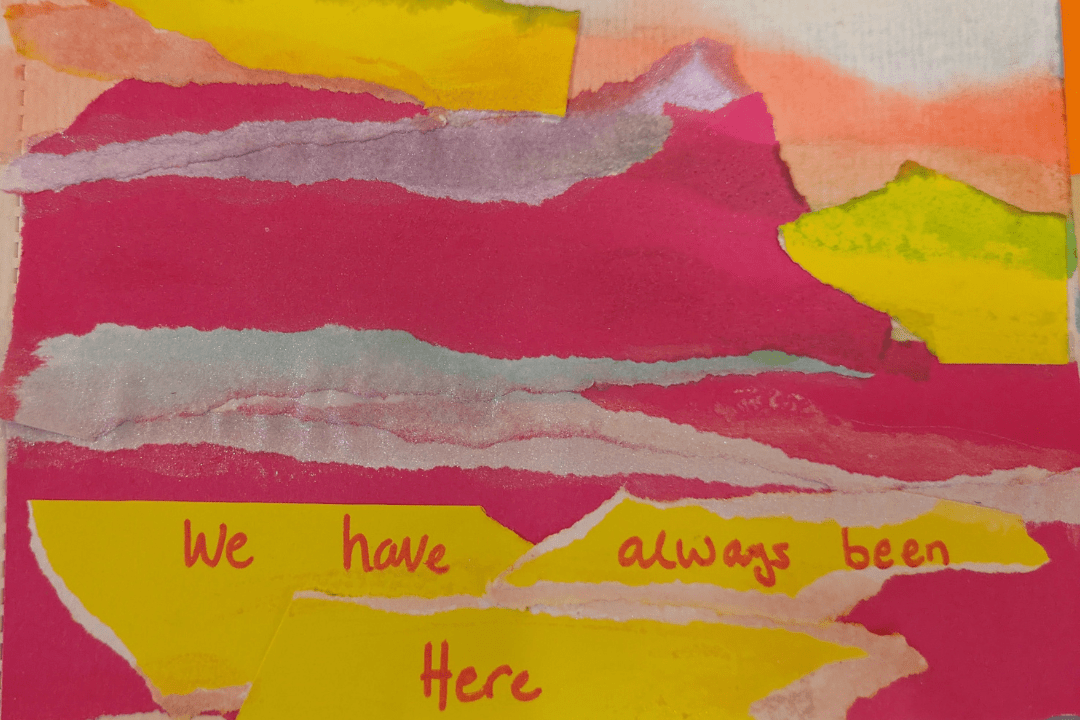
Using paints, pens, scissors, glue, pencils and words, participants created a piece of art that encapsulated whatever spoke to them the most from the day. They were fantastic works that will be used to help demonstrate the third therapeutic goal was achieved: increasing feelings of belonging and naturalness through a queering exploration of prehistoric Britain.
The project’s impact
Written over a year ago, my first blog about the project after a call with the Queer Natures team, shows the thinking behind my methods while designing this event – and last week, I burst out crying when I read the feedback it received. Every therapeutic goal was represented.
As a developing creative facilitator, I also learned from the event where I felt the gaps were, how easy it is for time-keeping to slip, and what I can do to make the event more enjoyable for everyone – so it was a win for me, too.
Future collaborations
Next on the cards: a wider run of the project for all members of Peak Queer Adventures (not just transgender* folks) – and a younger person’s version for SayIt Sheffield. I’m also putting some feelers out for any spring or summer festivals that might want a queer touch! So, if you’d like to collaborate, you can reach me over at the Contact Page, or email me at s.k.marley.author@gmail.com.
In the meantime, an enormous thank you to the participants who took the plunge on this new project and to the wonderful Queer Natures team, who helped it come into being.
In a time of increasing transphobia and biological essentialism, it’s good to celebrate our (tr)ancestry – an ancestry that acknowledges the fluidity of peoples and communities and cultures that have walked and shaped this land, including those that didn’t fit the mould.
“I felt connected to my community and to communities and people and the land stretching back thousands of years. I felt keen to share what I’d learned with others, both the historic perspectives and also the feelings and emotions the workshop had stirred.”
Before attending the Worcester University of Art’s Therapeutic Landscapes conference last year, I never thought physical objects from the past were special in their own right. I assumed their value was in their potential meanings and uses for their makers, unless they were particularly visually striking.
Since then, the other artists at the conference and my studies in Mesolithic Archaeology have taught me to see things differently. The materiality – the animate natures and imbued qualities that objects can hold when crafted with belief and hope – feels magical. To touch, hold, and feel the weight and texture of these objects is a more embodied engagement with culture for us, too. It helps my body feel more real.
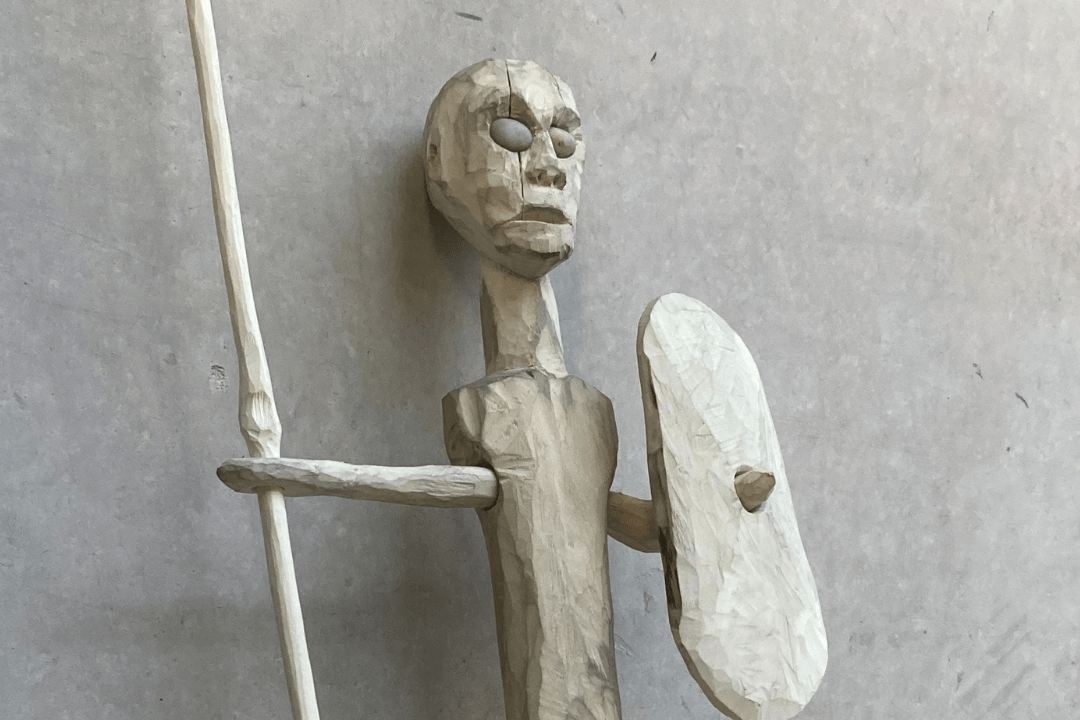
One such group of objects for me has been the Roos Carr god dollies. Last year, I hired a local artist to create a replica of one of these figures for Our Transcapes, which you can see at the top of this page. But why are they so exciting? When you’re trying to find evidence of non-dual living in prehistoric Britain and Ireland, they really hit the spot.
What’s a god dolly?
God dollies are wooden anthropomorphic figurines dating back to the Iron Age (c. 800 BCE – 43 CE), sometimes as far back as the Neolithic (the New Stone Age, c. 4,100-2,500 BCE). Interpreted as spiritually significant by archaeologists (hence their name, ‘god’ dolly), they were often deposited into bogs across North Europe as votive offerings.
On the continent, god dollies often come in ‘dimorphic pairs’ (where each doll represents one of the ‘binary’ sexes). But in Britain and Ireland, numerous figurines appear to represent sexes that are harder to categorise. For instance, some dolls have both male and female biological sex markers in one ‘body'(e.g., having both breasts and a phallus), while others have fluid sexes (such as having a removable phallus).
Discovering these objects was incredibly validating to me as a trans* person. It felt like they directly contradicted the current-day myths of the media: that transness – or any kind of non-binary mode of living – is new and unnatural. So how great would it be, I thought, to get one made? Briefing a professional artist to make a human figurine with a removable penis shouldn’t be too hard, right?
Jason Turpin-Thomson, Sheffield sculptor
Well, turns out you strike gold if you brief Jason Turpin-Thomson. After emailing tens of wood sculptors and artists from across the UK for this doll, only two responded – and one of them was perfect for our project.
Jason is a sculptor in Sheffield who has created many public works (the rocking chair in Rivelin River Valley, anyone?) His studio is littered with strange and wonderful sculptures made from bio-organic materials, like bone, wood, copper and iron. He undertook loads of research into these artefacts, and even visited the real Roos Carr figures in the Hull and East Riding Museum. I also learned that one of his family members belongs to the LGBTQ+ community. Perfect!
I couldn’t wait to collect the finished Roos Carr doll. Boy, the excitement I felt as I held it! Feeling that smooth holly, and the carved edges where Jason had used Iron Age-inspired tools and techniques, I found it easier than ever to relate to the Iron Age folks who made the originals. I can’t wait to see Our Transcapes participants get to do the same.
Thanks for bringing some ‘queer’ past to life, Jason – I hope to work with you again!